Community articles — Two-column
Kürzlich
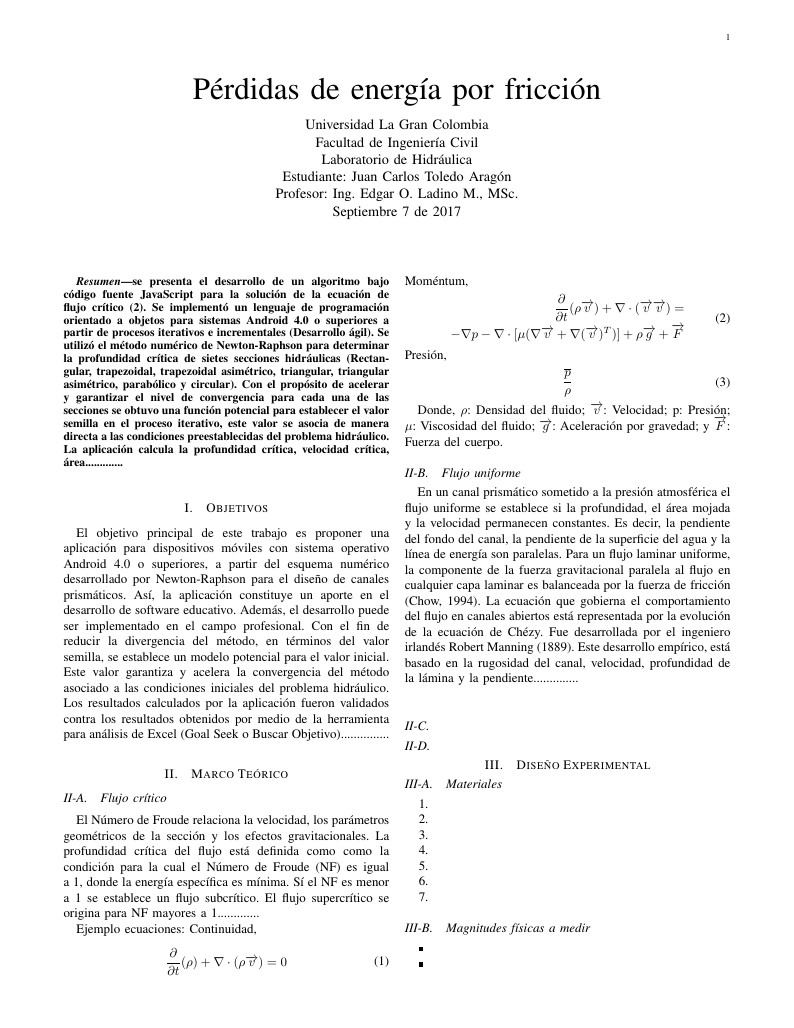
se presenta el desarrollo de un algoritmo bajo código fuente JavaScript para la solución de la ecuación de flujo crítico (2). Se implementó un lenguaje de programación orientado a objetos para sistemas Android 4.0 o superiores a partir de procesos iterativos e incrementales (Desarrollo ágil). Se utilizó el método numérico de Newton-Raphson para determinar la profundidad crítica de sietes secciones hidráulicas (Rectangular, trapezoidal, trapezoidal asimétrico, triangular, triangular asimétrico, parabólico y circular). Con el propósito de acelerar y garantizar el nivel de convergencia para cada una de las secciones se obtuvo una función potencial para establecer el valor semilla en el proceso iterativo, este valor se asocia de manera directa a las condiciones preestablecidas del problema hidráulico. La aplicación calcula la profundidad crítica, velocidad crítica, área
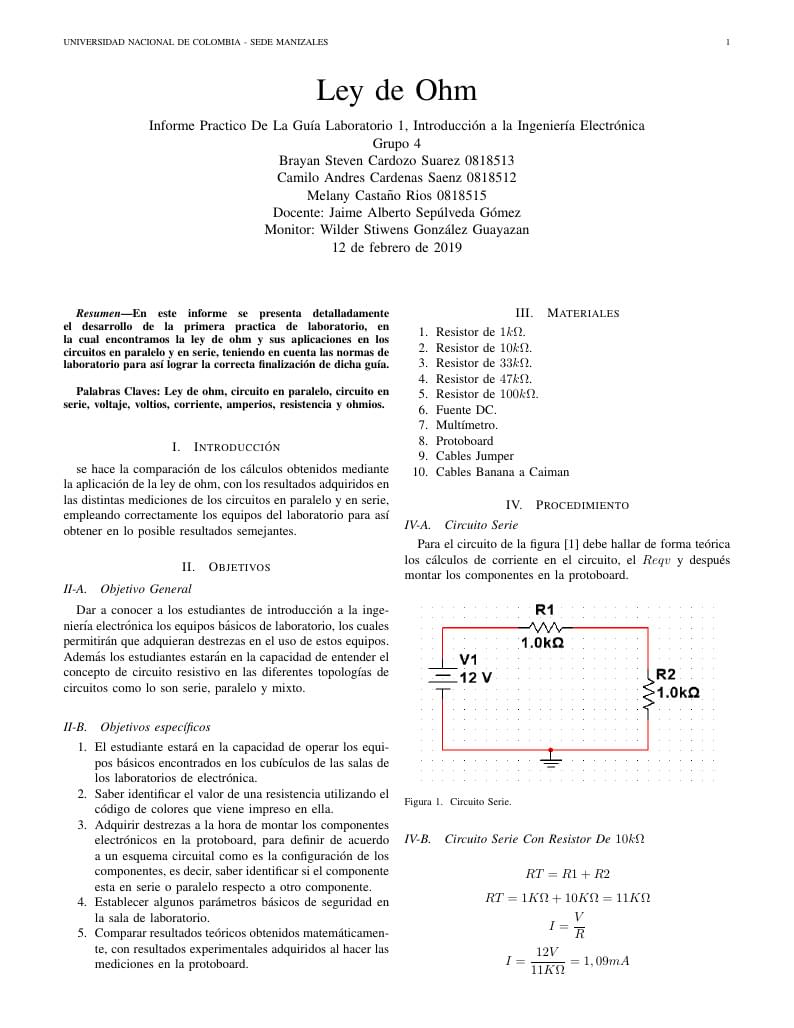
En este informe se presenta detalladamente el desarrollo de la primera practica de laboratorio, en la cual encontramos la ley de ohm y sus aplicaciones en los circuitos en paralelo y en serie, teniendo en cuenta las normas de laboratorio para así lograr la correcta finalización de dicha guía.
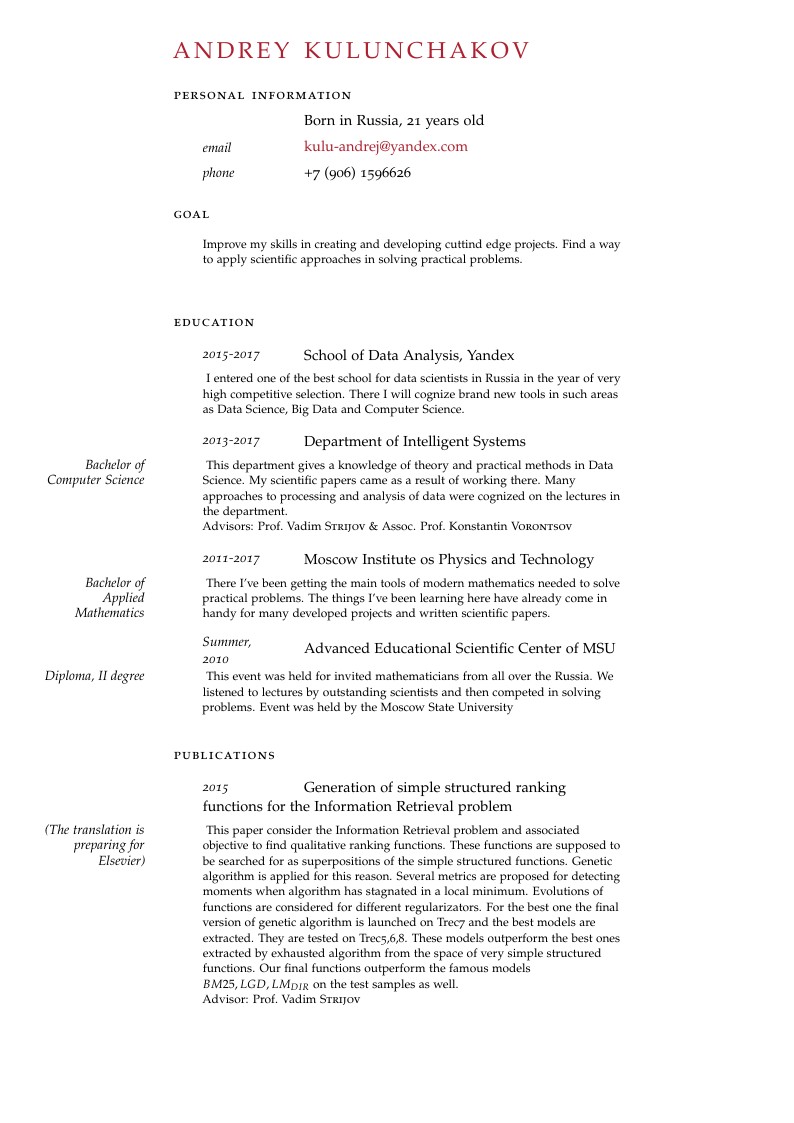
Created using the Classicthesis-Styled CV LaTeX Template Version 1.0 (22/2/13) from LaTeXTemplates.com, originally by Alessandro Plasmati
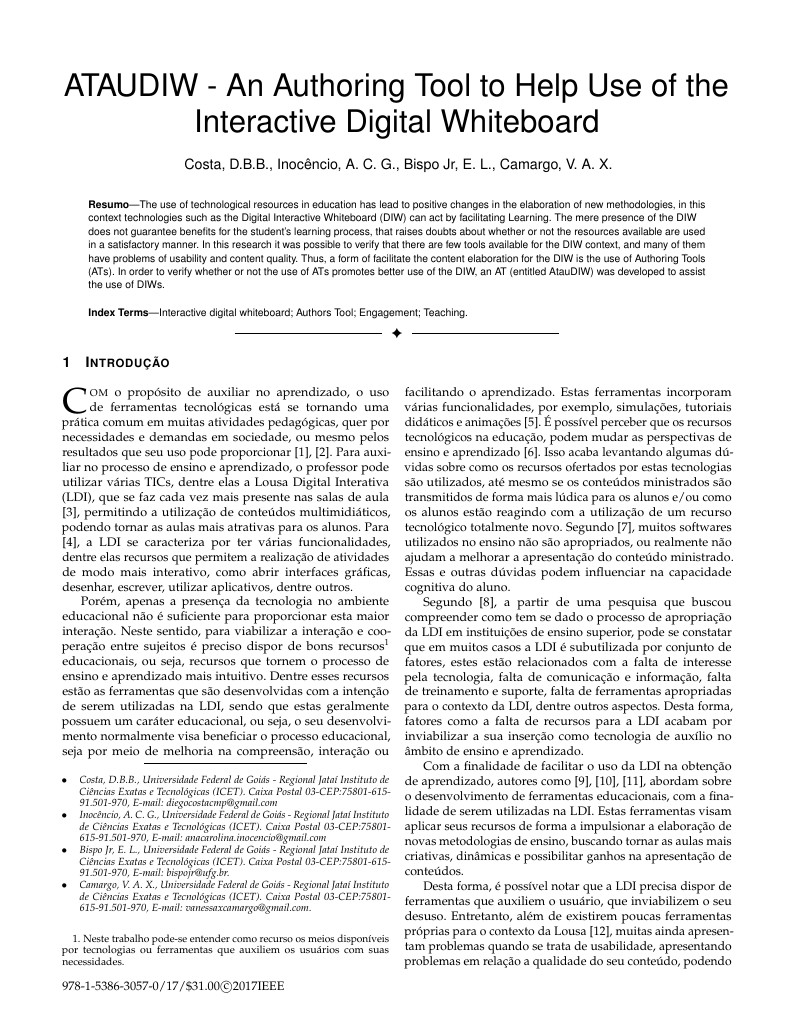
The use of technological resources in education has lead to positive changes in the elaboration of new methodologies, in this context technologies such as the Digital Interactive Whiteboard (DIW) can act by facilitating Learning. The mere presence of the DIW does not guarantee benefits for the student's learning process, that raises doubts about whether or not the resources available are used in a satisfactory manner. In this research it was possible to verify that there are few tools available for the DIW context, and many of them have problems of usability and content quality. Thus, a form of facilitate the content elaboration for the DIW is the use of Authoring Tools (ATs). In order to verify whether or not the use of ATs promotes better use of the DIW, an AT (entitled AtauDIW) was developed to assist the use of DIWs.
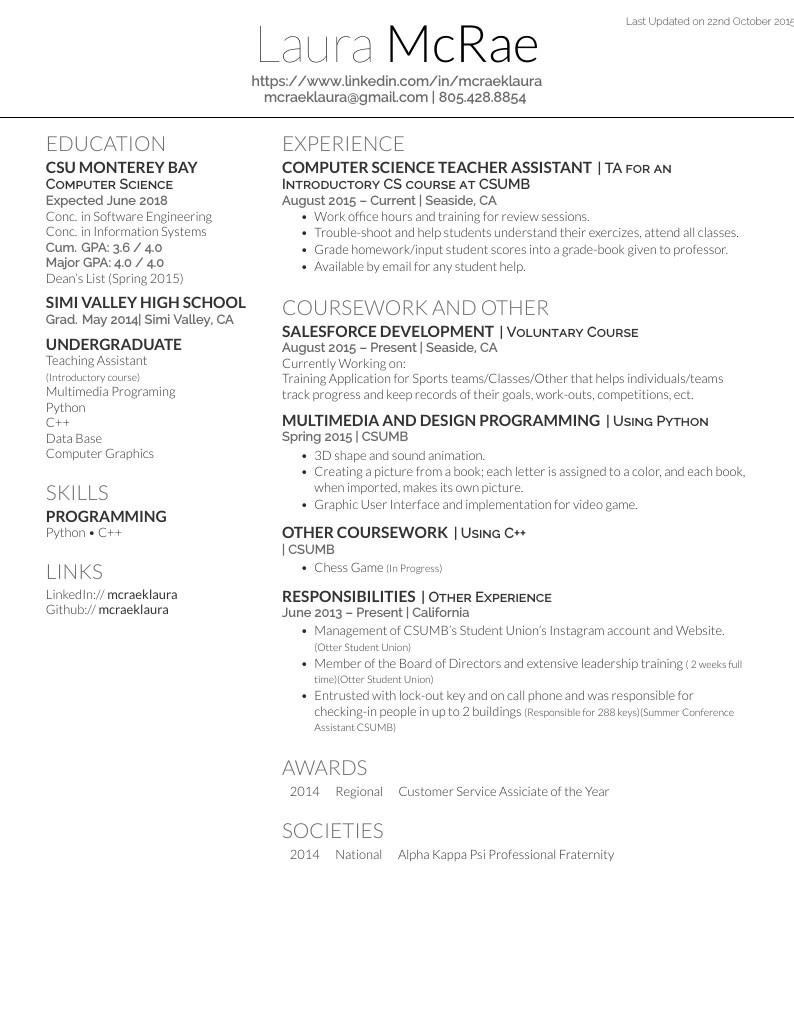
Created using the Deedy - One Page Two Column Resume from LaTeX Template, Version 1.1 (30/4/2014). Original author: Debarghya Das (http://debarghyadas.com) Original repository: https://github.com/deedydas/Deedy-Resume
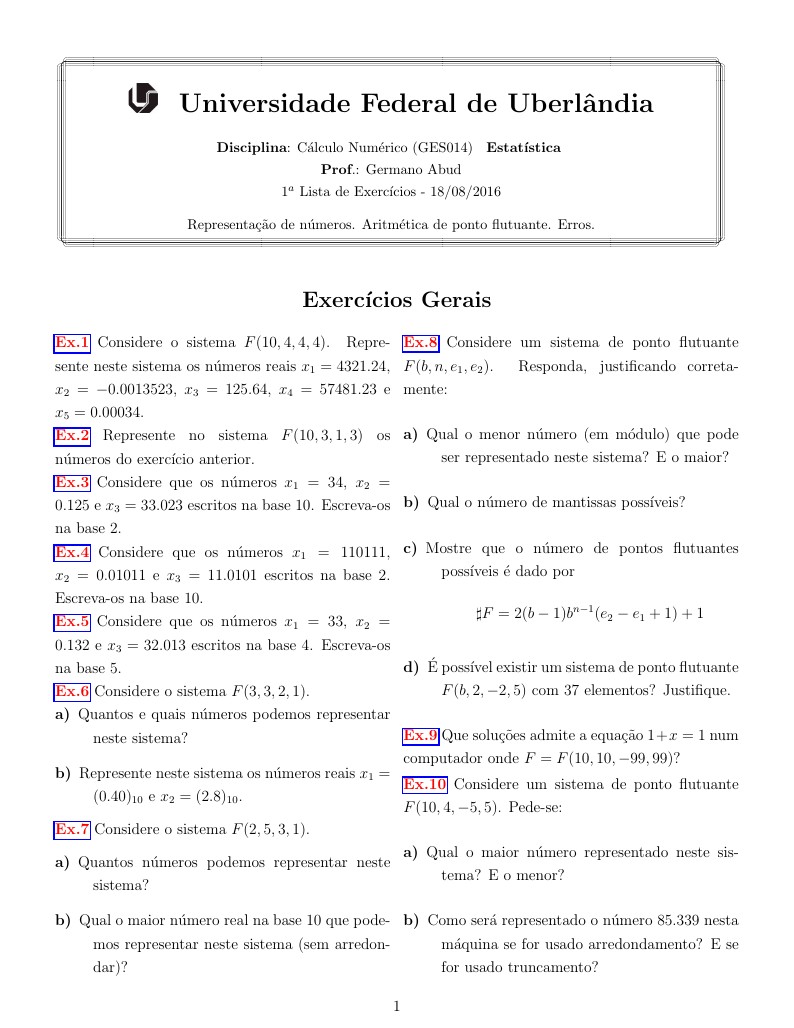
Lista de exercício com gabarito
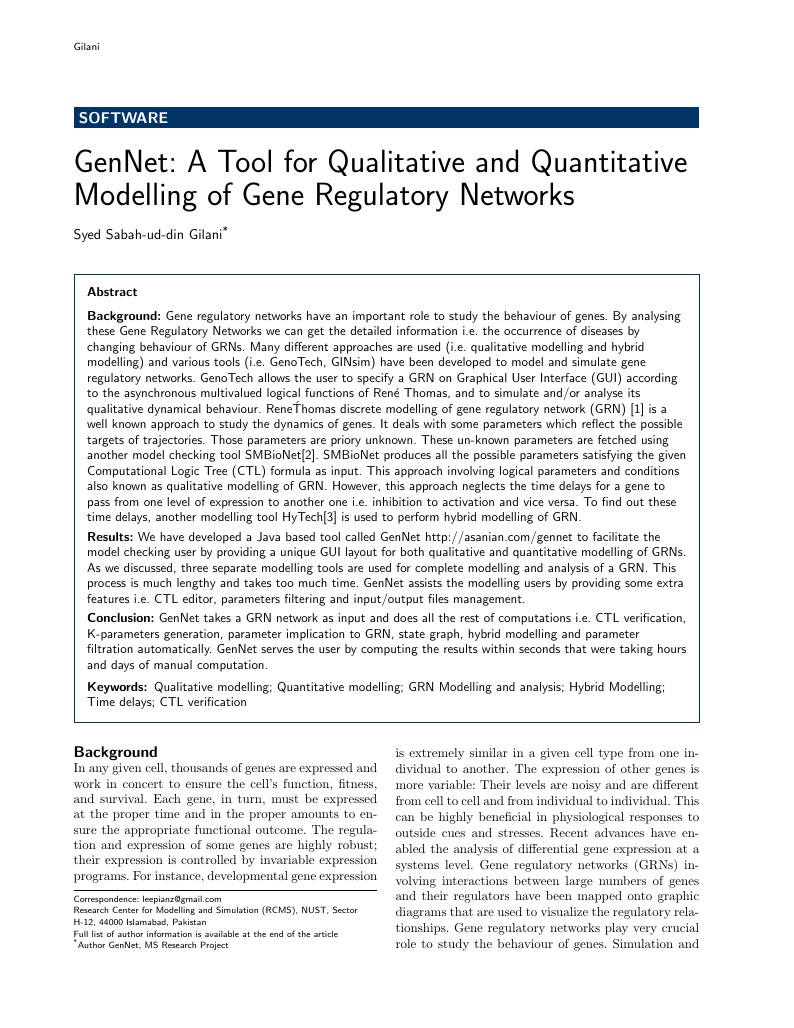
Gene regulatory networks have an important role to study the behaviour of genes. By analysing these Gene Regulatory Networks we can get the detailed information i.e. the occurrence of diseases by changing behaviour of GRNs. Many different approaches are used (i.e. qualitative modelling and hybrid modelling) and various tools (i.e. GenoTech, GINsim) have been developed to model and simulate gene regulatory networks. GenoTech allows the user to specify a GRN on Graphical User Interface (GUI) according to the asynchronous multivalued logical functions of René Thomas, and to simulate and/or analyse its qualitative dynamical behaviour. René Thomas discrete modelling of gene regulatory network (GRN) is a well known approach to study the dynamics of genes. It deals with some parameters which reflect the possible targets of trajectories. Those parameters are priory unknown. These unknown parameters are fetched using another model checking tool SMBioNet. SMBioNet produces all the possible parameters satisfying the given Computational Logic Tree (CTL) formula as input. This approach involving logical parameters and conditions also known as qualitative modelling of GRN. However, this approach neglects the time delays for a gene to pass from one level of expression to another one i.e. inhibition to activation and vice versa. To find out these time delays, another modelling tool HyTech is used to perform hybrid modelling of GRN. We have developed a Java based tool called GenNet http://asanian.com/gennet to facilitate the model checking user by providing a unique GUI layout for both qualitative and quantitative modelling of GRNs. As we discussed, three separate modelling tools are used for complete modelling and analysis of a GRN. This process is much lengthy and takes too much time. GenNet assists the modelling users by providing some extra features i.e. CTL editor, parameters filtering and input/output files management. GenNet takes a GRN network as input and does all the rest of computations i.e. CTL verification, K-parameters generation, parameter implication to GRN, state graph, hybrid modelling and parameter filtration automatically. GenNet serves the user by computing the results within seconds that were taking hours and days of manual computation
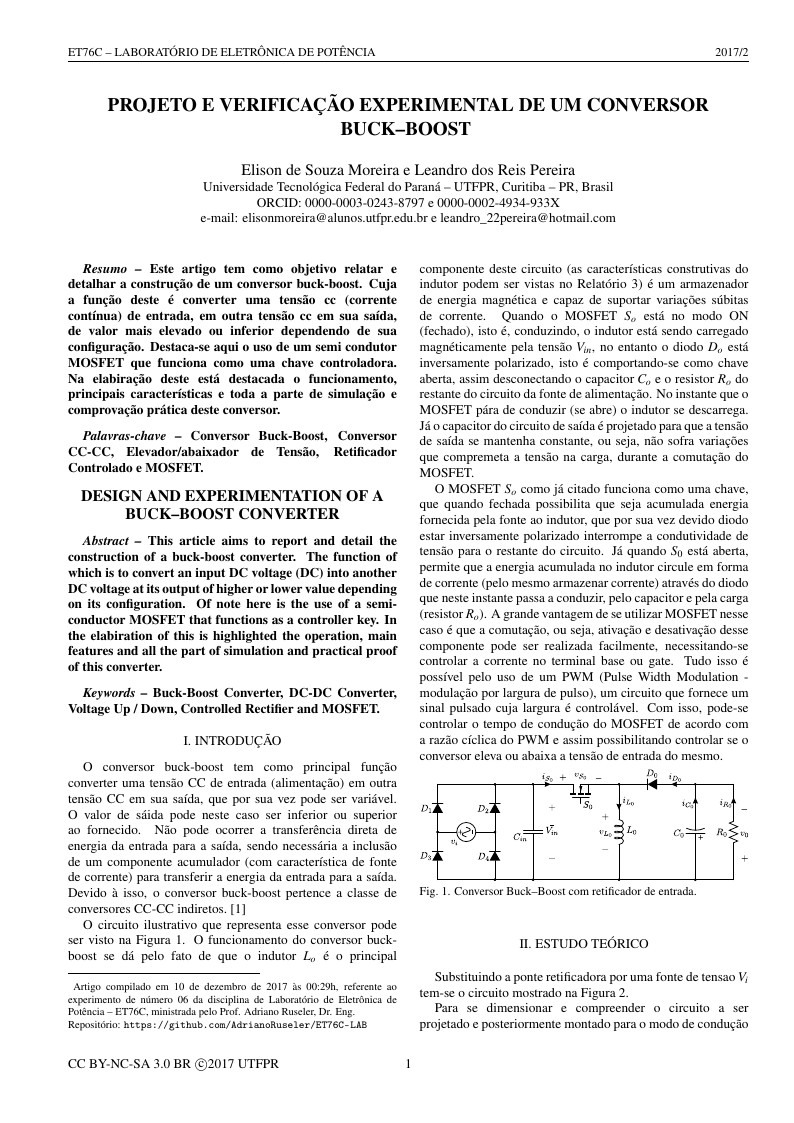
Este artigo tem como objetivo relatar e detalhar a construção de um conversor buck-boost. Cuja a função deste é converter uma tensão cc (corrente contínua) de entrada, em outra tensão cc em sua saída, de valor mais elevado ou inferior dependendo de sua configuração. Destaca-se aqui o uso de um semi condutor MOSFET que funciona como uma chave controladora. Na elabiração deste está destacada o funcionamento, principais características e toda a parte de simulação e comprovação prática deste conversor.
Inconel 718 is the most employed superalloy in the industry and it is often found in aerospace engines and power generation turbines. Superalloys are known as one of the most difficult group of materials to machine and therefore, tool material, tool geometry and cutting parameters should be carefully selected. Numerous researches have proven the enhanced productivity in turning of ceramic tools compared to carbide ones, while considerably less information is with regard to milling. Moreover, no knowledge has been developed about machining holes with this type of tools. More research on different machining techniques like circular ramping is critical to expand the productivity improvements that ceramics offer. This paper initially reviews prior work about ceramic tools. Then, a 3D simulation and a number of experiments with SiAlON round inserts have been carried out to evaluate the effect of the cutting speed and pitch on the tool wear and chip generation. The results show that three different types of chips are generated as well as that there are three potential wear zones. Top slice wear was identified as the most critic wear type followed by the notch wear. Flank wear and adhesion were also found in most of the tests. To conclude with, a 6.6 times more productive process than with carbide tools was achieved. Cet article étudie deux méthodes utilisées dans le cadre du transport humanitaire en cas de crise (désastre, épidémie...). Le Covering Tour Problem se focalise sur l'équité de distribution des vivres, alors que le Capacitated Vehicle Routing Problem se concentre sur l'urgence de la distribution. Nous proposons une nouvelle approche mélangeant ces deux approches pour former une solution à la fois équitable et rapide. Ce article a été rédigé dans le cadre du TER 2014-2015.
\begin
Discover why over 30 million people worldwide trust Overleaf with their work.